Illuminated dubai skyline at night

Setting up a business in the UAE can feel like standing in front of a buffet of opportunity: over 40 free zones, each offering specific benefits, costs, and sector specializations. But which UAE Free Zone is right for your business?

Whether you’re launching a consultancy, relocating your holding company, or planning a tech startup, choosing the right free zone is a crucial step that affects your operations, tax exposure, reputation, and scalability.

In this guide, we demystify the UAE’s free zone landscape to help you make an informed, strategic choice.

What is a Free Zone?

A free zone is a designated area within the UAE where companies benefit from unique incentives:

  • 100% foreign ownership
  • No personal or corporate income tax (subject to conditions)
  • Customs duty exemptions on imports and exports
  • Simplified company formation procedures
  • Sector-focused infrastructure and licenses

Free zones operate under their own regulations, managed by autonomous authorities, and are typically not allowed to trade directly with the UAE mainland unless specific dual licenses are obtained.

How to choose the right Free Zone: key criteria

Choosing a free zone isn’t just about the cheapest license. Consider these strategic factors:

1. Business Activity and Sector Relevance

Some zones are generalist; others are themed:

  • Generalist zones like Meydan Free Zone or IFZA offer flexibility for consulting, trading, and holding activities.
  • Themed zones like DIFC (finance), DMCC (commodities and crypto), or DIC (technology) cater to specific industries and may offer reputational or regulatory advantages.

Tip: Match your activity with the zone’s core focus. Operating outside your sector may be prohibited or penalized.

2. Location and Prestige

Are you client-facing or logistics-heavy? Do you need to impress investors or reduce costs?

  • Premium zones like DIFC, DMCC, and JAFZA offer central locations, high-end facilities, and strong banking credibility.
  • Value zones like Ajman Free Zone or UAQ FTZ offer low-cost setups near ports or industrial areas.
  • Zones like Meydan or DWTC blend affordability with strategic location.

Tip: Proximity to clients, banks, and transport hubs matters for branding and logistics.

3. Visa and Staffing Needs

Each free zone has different quotas and rules for employee visas:

  • Meydan allows up to 6 visas per flexi-desk.
  • IFZA and AFZ offer up to 2 visas per desk, sufficient for lean teams.
  • Some zones require dedicated office space for more than a few visas.

Tip: Consider your hiring plans — visa limits can quickly become a constraint.

4. Office Requirements and Facilities

Office types range from virtual desks to warehouses:

  • Virtual or flexi-desks are cost-effective but may limit ESR compliance or visa eligibility.
  • If you need storage or production, look at zones like JAFZA, DSO, or UAQ FTZ offering warehouses and industrial units.

Tip: Don’t overlook infrastructure — your physical setup must match your business model.

5. Setup Time and Administrative Ease

  • Some zones like Meydan and IFZA boast 3–5 day registration times.
  • Others like DIFC and ADGM may require 4–6 weeks or more, particularly for regulated activities.

Tip: Fast isn’t always better — weigh speed against structure and credibility.

6. Cost Structure

Costs vary widely:

  • Low-cost: Ajman Free Zone (AED 8,600), UAQ FTZ (AED 10,700)
  • Mid-range: IFZA (AED 15,200), Meydan (AED 16,700)
  • Premium: DMCC (AED 49,790), JAFZA (AED 58,200)

These often exclude additional costs like visas, office rent, and banking.

Tip: Factor total cost of ownership, not just registration fees.

7. Banking and Legal Structure

  • DIFC and ADGM follow common law frameworks — ideal for financial institutions, family offices, and global investors.
  • DMCC and DWTC are highly rated by banks and enable dual licensing, allowing mainland business without physical expansion.

Tip: If banking is a priority, opt for zones with proven bankability.

UAE Business Setup Checklists & Toolkit

A practical toolkit outlining the key steps, documents and considerations involved in setting up a company in the United Arab Emirates.

Popular Free Zones by business type

Here’s a quick match-up of business types and recommended zones:

Business Type Suggested Free Zones
Consulting / Freelance Meydan, IFZA, AFZ
Trading (Import/Export) JAFZA, DMCC, UAQ FTZ
Tech Startup DSO, DIC, IFZA
Holding Company / IP Structure ADGM, DIFC, Meydan
Crypto / Blockchain DMCC, DWTC
Logistics / Manufacturing JAFZA, DS, UAQ FTZ
Family Office / HNW Structure DIFC, ADGM, DWTC


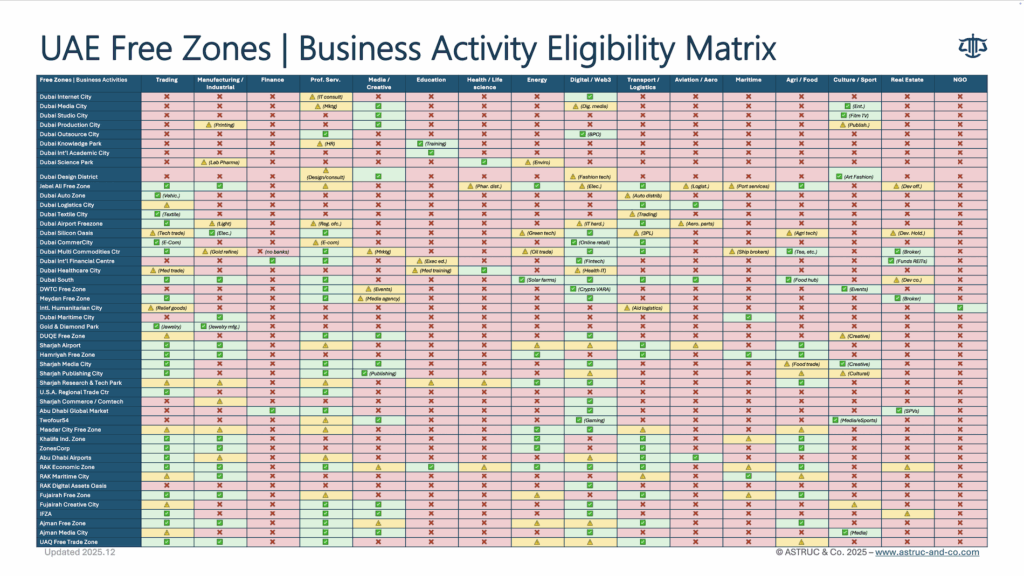
All Free Zones by business type

Matrix of UAE free zone business activities


Economic substance and corporate tax considerations

Since 2019, UAE companies undertaking certain “relevant activities” must meet Economic Substance Regulations (ESR), proving they have real presence in the UAE.

Using a virtual office might not be enough for ESR or UAE Corporate Tax exemption. Substance requirements include:

  • Real operations in the UAE
  • Local employees or management
  • Physical presence

Tip: If your business falls under ESR or seeks tax exemption, consult a legal advisor before choosing a free zone.

What’s the best Free Zone? It depends on you.

There’s no one-size-fits-all answer. The best free zone depends on:

  • Your industry
  • Budget
  • Licensing needs
  • Growth plans
  • Credibility and tax exposure

Many of our French-speaking clients at ASTRUC & Co combine legal structuring with market expansion strategy — we often recommend dual setups (e.g. a free zone holding company with a mainland branch) for maximum flexibility.

UAE UAE Free Zones – Comparison Chart

Comparison of UAE free zones benefits


Notes:

  • Visa Quotas: Visa allocations are generally linked to the type and size of office space. For instance, in DMCC, companies are allowed one visa for every 9 square meters of office space .
  • Audit Requirements: Certain free zones mandate annual audits, especially for companies exceeding specific revenue thresholds.
  • Capital Requirements: While many free zones have waived minimum capital requirements, some, like DMCC and DIFC, still enforce them.
  • Setup Costs: The costs mentioned are approximate and can vary based on business activities, office space, and additional services.
  • Mainland Access: As of 2025, Dubai Executive Council Resolution No. (11) allows free zone entities to expand into mainland Dubai through new licensing options .

If you need further assistance in selecting the most suitable free zone for your business or require more detailed information on specific zones, feel free to ask!


Sources & resources (official / practical references)

1) UAE Ministry of Economy – Steps to establish a company (mainland)
https://www.moet.gov.ae/en/establishing-companies

2) UAE Government Portal (u.ae) – Starting a business in a free zone (high-level overview)
https://u.ae/en/information-and-services/business/doing-business-in-free-zones/starting-a-business-in-a-free-zone

3) UAE Ministry of Finance – Corporate Tax (incl. free zone concept and conditions)
https://mof.gov.ae/en/public-finance/tax/corporate-tax/

4) UAE Federal Tax Authority – Corporate Tax Guide (Free Zone Persons)
https://tax.gov.ae/Datafolder/Files/Guides/CT/Free%20Zone%20Persons%20-%2020%2005%202024%20final%20for%20GCD.pdf

5) UAE Ministry of Finance – Economic Substance Regulations (ESR) hub + guidance
https://mof.gov.ae/en/public-finance/international-relations/economic-substance-regulations/

NEWSLETTER

Sign up for our legal insights

Receive practical legal updates, guides and insights on business, investment and life in the UAE.

By submitting this form, I agree to the Terms of Use and Data Privacy Policy. You can unsubscribe at any time by clicking on the unsubscribe link at the end of the newsletter message. Details about how data is processed can be found in our Privacy Policy.

One hour consultation

30-minute consultation

Merger and Acquisition
Private Equity
Banking &Finance
Commercial
Construction
Employment Relationship
HR Strategy – Advisory Services
Business Set-Up and Maintenance
Joint Venture and Investors Relationship
Expatriation Services
Relocation
Advisory
Litigation
Civil Status
Nationality and Immigration
Succession Planning
Inheritance Proceedings
Crime against the Person and Narcotics
Business Crimes
Marriages
Divorces